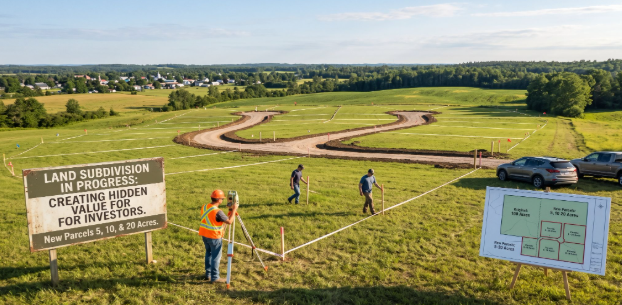
While most investors treat raw acreage as a passive buy-and-hold asset, institutional operators generate superior returns through structural parcel arbitrage specifically, subdividing land for profit. Backed by 14 years of transaction data across international markets, smaller parcels consistently capture a substantial price-per-acre premium over large tracts due to higher buyer liquidity and lower absolute capital requirements.
By acquiring wholesale acreage and steering it through the legal land subdivision process balancing county zoning, utility engineering, and optimal platting investors can manufacture immediate equity, transforming illiquid land into multiple high-margin exits.
Why smaller parcels can be more valuable per acre
One of the most consistent observations in land investing is that smaller parcels consistently command a higher price per acre than larger tracts.
Several key market drivers explain this pricing spread:
- Supply and Demand: Smaller parcels attract a broader, more competitive pool of retail buyers.
- Market Liquidity & Usability: Lower total capital requirements make smaller acreage easier to finance, acquire, and develop for immediate end-use.
- Development Economics: Costs to clear, grade, and improve land scale differently across smaller configurations.
- Infrastructure & Accessibility: Extending utilities (drilling water wells, pulling electrical power, building roads) and securing physical access can be capitalized more efficiently on smaller footprints.
- Zoning & Regulatory Carry: Permitted land uses, local zoning densities, and recurring property taxes favour right-sized parcel sizes.
Empirical evidence: parcel size vs. price per acre
This valuation disparity is not limited to a single geography or asset class; it is an established economic dynamic confirmed across international markets.
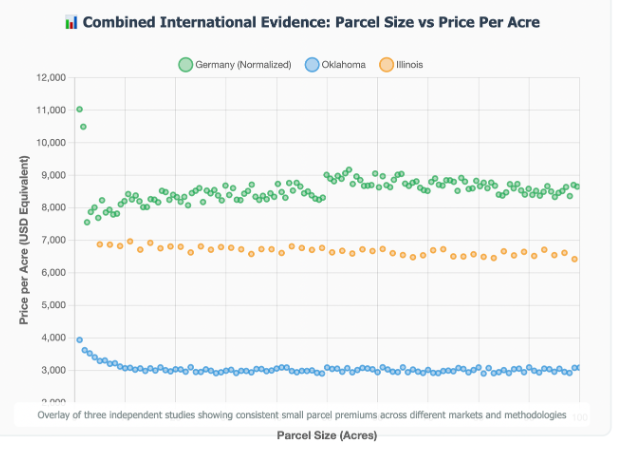
Figure 1: Longitudinal data combining three independent studies across Germany, Oklahoma, and Illinois over a 14-year period (2006–2020), demonstrating a consistent small-parcel price premium.
Historical market data confirms several key patterns:
- Small-Parcel Premium: Across all three independent studies (Germany, Oklahoma, and Illinois), smaller acreage captures the highest unit pricing per acre.
- Wholesale-to-Retail Spread: As parcel size increases toward large bulk acreage, unit pricing levels off to wholesale rates creating the exact arbitrage margin captured through strategic subdivision.
- Cross-Market Consistency: Covering a combined 14-year timeline across two continents, the data proves that small-parcel premium demand remains structural regardless of differing local regulations or economic cycles.
How subdividing a large parcel can create value
A basic land subdivision strategy is to acquire a larger parcel and, where legally and economically appropriate, divide it into smaller parcels. For example, a large parcel may be purchased at a lower price per acre than comparable smaller parcels. If that parcel can then be divided into multiple smaller parcels and those parcels command a higher price per acre, the total value of the resulting parcels may be greater than the original acquisition value.
The concept can be summarized simply:
Large parcel → Strategic division → Smaller parcels → Potentially higher value per acre
However, a higher potential sales value does not automatically mean higher profit. Investors must consider the costs and time of the division process, along with market conditions and applicable regulations.
What determines whether land can be divided?
Complexity of land subdivision depends on several factors, many of which investors can evaluate before moving forward.
- Zoning and Land-Use Rules: The zoning of the subject land can determine what uses are permitted and what type of division may be possible.
- County and State Regulations: Land division requirements vary by county and state. The location of the property is therefore an important consideration when evaluating a subdivision opportunity.
- Original Parcel Size and Number of Parcels: The size of the original parcel and the number of new parcels an investor wants to create can affect the complexity of the process.
- Selected Method of Division: There are multiple ways land can be divided, and the appropriate method depends on the property and circumstances.
- Investment Time Horizon: The time horizon also matters. Land is generally a long-term investment, and a longer horizon can provide more options for pursuing a value-creation strategy. Land Value Alpha strongly recommends a 7–10 year investment horizon to maximize potential returns.
Common ways land can be divided
Land can be divided through a variety of methods. The applicable options and requirements vary by state, county and specific property.
Examples include:
- Family transfers
- Major subdivisions
- Minor subdivisions
- Boundary line adjustments or relocations
- Montana Subdivision and Platting Act exemptions, including applicable agricultural, commercial and industrial exemptions
- Court-ordered partitions
- Foreclosure proceedings
- Easement creations
- Trust or estate divisions
- Condominium or townhome conversions
- Homeowners Association (HOA) divisions
Many of these approaches exist in multiple states, but the specific requirements and processes can vary significantly.
Montana: a practical example of land division
Montana provides a useful example of how many different land division approaches can exist within one state. Depending on the circumstances, landowners may have options that include family transfers, major or minor subdivisions, boundary line adjustments, applicable exemptions, court-ordered partitions, easements, estate or trust divisions, and various rights-related divisions.
The key point is that having multiple potential methods does not mean every method is available for every property. County requirements, property characteristics, zoning and the selected method of division all matter. Before proceeding with a land division, investors should consult a local attorney or land-use professional who understands the applicable county and state requirements.
Does subdivision always increase profit?
No. Subdivision can create an opportunity for value creation, but it does not guarantee a profit.
Potential outcome depends on multiple factors, including:
- Acquisition price
- Resulting price per acre
- Subdivision requirements
- Legal and regulatory considerations
- Infrastructure requirements
- Market demand
- Investment timeline
- Costs associated with creating and selling the resulting parcels
Distinction is important because a higher price per acre for smaller parcels does not automatically translate into a higher net return. Investors must evaluate the complete economics of the opportunity.
How investors can evaluate a land subdivision opportunity
A potential subdivision investment can be evaluated by looking at several factors together. First, investors can examine the original acquisition price and determine whether the larger parcel is priced attractively relative to comparable land. Next, they can assess the subdivision potential, including zoning, parcel size, the number of parcels that may be created and the applicable county rules. The next step is understanding the selected division method and the requirements associated with it. Infrastructure, accessibility and other property-specific considerations can also affect the opportunity.
Finally, investors should consider the investment time horizon and the potential value of the resulting parcels rather than focusing only on the original acreage. The objective is not simply to divide land. It is to determine whether the strategy can create enough additional value to justify the associated complexity, costs and time.
Think beyond the acre
Land investors often focus on how many acres they can acquire and the price they pay per acre. But another useful question is what those acres could potentially be worth if the land were strategically divided. Smaller parcels can command higher prices per acre than larger parcels, and this difference has been observed across multiple markets and periods. Strategic land subdivision can therefore provide a potential path to creating value.
At Land Value Alpha, the targeted return profile is 20% CAGR, which equates to approximately 2.5× the original investment over five years. This is a targeted return profile, not a guarantee, and the actual outcome depends on the property, strategy and market.
Our core idea is simple: if you have a choice between buying a small parcel at a premium price per acre and acquiring a larger parcel with the potential to divide it, consider the larger parcel and think beyond the acre.
Frequently Asked Questions (FAQs)
Is subdividing land a good investment strategy?
It can be a potential value-creation strategy when the property, market, regulations and economics support subdivision. However, subdivision does not guarantee a profit, and each opportunity needs to be evaluated individually.
How long does it typically take to subdivide land?
The timeline varies depending on the location, division method, county requirements, number of parcels and other property-specific factors. A longer investment horizon can provide more flexibility when pursuing land subdivision strategies.
Can land be subdivided without building roads or utilities?
The requirements depend on the property, location, zoning and applicable subdivision rules. Infrastructure and accessibility are among the factors that should be evaluated before determining whether a subdivision strategy is viable.
What professionals should I consult before subdividing land?
Because requirements vary by county and state, investors should consult a local attorney or land-use professional before proceeding with a land division.
Tags: land subdivision, subdividing land, subdividing land for profit, land subdivision investment, land subdivision costs, land subdivision process, is subdividing land profitable, subdivide land to increase value