
Most investors spend their valuable time looking for the next breakout stock, relying on index funds, or following the buzz around tech giants like the Magnificent 7. But while the spotlight stays on Wall Street, a much quieter opportunity is slowly taking shape in the background.
Water, often called “blue gold, water rights are catching the eye of thoughtful investors as clean freshwater becomes harder to come by. Between growing cities, expanding populations, and rising industrial needs, the pressure on global water supplies is very real. As these quiet trends unfold, more people are realizing that owning water rights isn’t just a trend; it’s a patient, resilient asset built on simple necessity and true scarcity.
Why water is becoming the world’s next critical asset
Water is something most of us never think about until access becomes a problem. Yet it quietly supports almost everything we depend on, from daily life and agriculture to business and economic growth.
For a long time, the market treated water as a simple public commodity. Today, that view is shifting rapidly. Between climate shifts, growing cities, and skyrocketing tech demands, where a single AI data centre can gulp hundreds of thousands of gallons of clean freshwater every single day, reliable supply is getting harder to secure.
It’s now a critical factor in agriculture, energy, manufacturing, and AI infrastructure. As demand keeps rising, the ability to lock in legal water access is turning into a massive strategic advantage across global markets.
Hidden crisis: Growing demand meets limited water
Day by day, water is becoming a valuable economic asset as global demand continues to grow and reliable supplies become harder to secure.
A single AI data centre can consume around 300,000 gallons of water every day, equivalent to the daily usage of 100,000 homes. Over the past three years, more than 160 new data centres have been built in drought-prone regions, creating an entirely new source of industrial water demand.
At the same time, natural freshwater supplies face mounting pressure. In 2023, glaciers lost 600 gigatons of water, marking the largest annual loss in fifty years. Together, a plummeting natural supply and an exploding industrial demand are reshaping how governments, industries, and investors think about water.
How AI data centres are creating a new wave of water demand

Artificial intelligence feels purely digital, but every AI breakthrough depends on heavy physical infrastructure operating behind the scenes. Large-scale data centres generate immense heat and require significant water cooling to maintain performance. As investment in AI infrastructure accelerates, tech companies are consuming water at record levels:
- Microsoft reported a 34% increase in water consumption in a single year.
- Google uses approximately 5.56 billion gallons of water annually, roughly 800 times the capacity of the Lincoln Memorial reflecting pool.
- ChatGPT has also raised concerns about AI’s hidden water footprint. A UC Riverside study estimated that a typical ChatGPT conversation of 20 to 50 questions could consume around 500 millilitres of fresh water, depending on where and how the AI is running.
- By 2027, AI could account for 4.2 to 6.6 billion cubic meters of global water withdrawal every year.
Every ChatGPT query, every AI image generated, and every autonomous vehicle calculation depends on infrastructure that ultimately relies on water. As AI adoption expands, it creates a rapidly growing source of long-term water demand.
Why water rights are becoming the foundation of blue gold investing
As water attracts attention from investors, the conversation is shifting from generic corporate stocks to the actual rights that control access to the water itself. Water rights provide ironclad legal access to one of the world’s most essential resources, backed by property rights with over 150 years of legal precedent. This is the core idea behind Blue Gold investing. Rather than focusing only on utility companies or broad funds, investors are looking at direct ownership of the underlying asset.
As demand continues to grow and freshwater becomes limited, water rights stand out as a long-term investment backed by absolute scarcity and non-negotiable demand.
Why traditional water investments may be missing the bigger opportunity
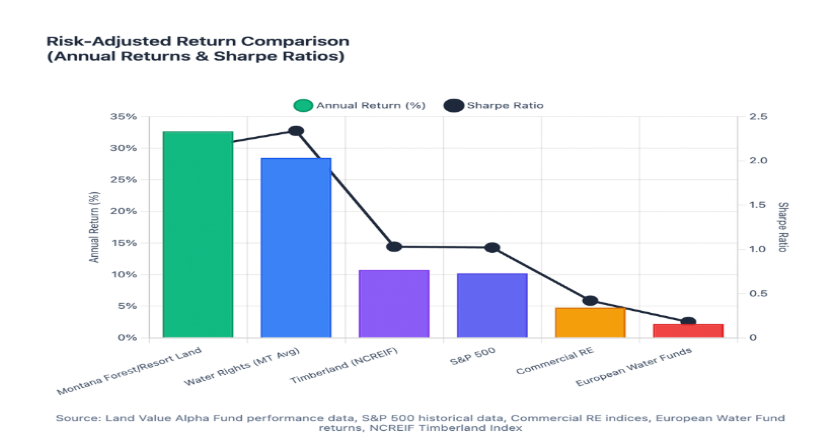
Risk-Adjusted Return Comparison
Not every water investment delivers the same opportunity. Many retail investors gain exposure through traditional water funds or broad sector ETFs, but direct ownership tells a completely different story.
According to market performance data:
- European water funds returned a modest 2.2% last year.
- Direct water rights ownership delivered 28.48% returns.
That is a 13x performance gap. Traditional water funds carry corporate overhead and stock market volatility, whereas direct ownership links returns straight to real-world supply and demand on the ground.
Why Montana is emerging as a water rights investment opportunity
Montana is attracting growing attention as one of the few places where premium water rights remain remarkably affordable. While water rights in California can exceed $8,000 per acre-foot and prices in Colorado have reached $65,000, comparable high-quality water rights in Montana are still available for under $650.
That pricing advantage won’t last forever, given Montana’s market conditions:
- Drought Vulnerability: Montana ranks as the #2 most drought-vulnerable state in the U.S., with 59% of the state currently experiencing moderate to extreme drought.
- Agricultural Impact: In 2017 alone, a sudden flash drought resulted in $2.6 billion in agricultural losses.
- Extremely Tight Supply: Only 47 properties with significant water rights were listed for sale in 2024.
- Headwater Advantage: As a primary headwater state where many major rivers in the western U.S. begin, Montana holds a unique top-of-the-funnel position.
Institutional buyers recognised this setup early, acquiring 66% of Montana’s available water rights inventory last year.
Why water rights protect your portfolio
Direct water rights offer downside protection and stability that are nearly impossible to find in regular equities or real estate:
- Essential Demand: People, farms, and modern tech literally cannot operate without it.
- Absolute Scarcity: You cannot print or manufacture more freshwater.
- Negative Correlation: Water rights carry a negative correlation with both traditional stocks (-0.15) and bonds (-0.23).
To put that resiliency into perspective: during the 2008 financial crisis, while real estate crashed by 33%, direct water rights actually appreciated by 8%.
Future of water rights investing: Why the window may not stay open forever
Institutional interest in water assets is no longer a future possibility; it’s happening now. Harvard’s endowment fund has been quietly acquiring agricultural land tied to senior water rights, while pension funds are targeting 3% to 7% portfolio allocations directly to water-related assets.
As institutional buyers acquire more of the available market, ground-floor entry points for individual investors will naturally tighten. Like many emerging real asset classes, the greatest opportunities exist before institutional demand fully saturates the space.
Bottom Line
Water is no longer just a natural resource. It is becoming a strategic asset driven by growing demand, tightening supplies, and the rapid expansion of AI infrastructure. As institutional investors move deeper into the market, water rights are emerging as a unique way to gain exposure to one of the world’s most essential and increasingly scarce resources. For investors willing to look beyond traditional assets, the opportunity may be larger than most people realize.
Frequently Asked Questions(FAQs)
1. How does a data centre or factory actually pay a water rights holder?
Companies enter into long-term lease or purchase contracts with water rights owners to guarantee a steady, legal supply of freshwater needed to run and cool their facilities.
2. How do investors make money from owning water rights?
Primarily through long-term asset appreciation as scarcity grows, or by leasing the water rights to local farmers, industrial projects, municipalities, and data centres.
3. How are tech companies and AI expansion creating direct revenue opportunities for water rights holders?
AI data centres require massive cooling infrastructure and can consume up to 300,000 gallons of water daily. Industrial users and tech giants actively enter into long-term lease or purchase agreements with water rights holders to secure the legal water volume required to keep critical facilities operational.
Tags: Montana water rights investment, Montana water rights, Montana water rights for sale, Montana water investment, investing in Montana water rights, Montana water rights value, Montana water market, Montana water scarcity, Montana agricultural water rights, AI water consumption, AI infrastructure water demand, water rights for data centers, water rights investing, investing in water rights, water investment opportunities, water rights investment USA, Montana water rights investment,